
A craving can feel like it will keep climbing until you give in. Usually it doesn't. Urges tend to build, peak and fade on their own, a lot like a wave. Urge surfing is the practice of riding that wave: noticing the craving, staying with it, and letting it pass without fighting it or acting on it.
Where does urge surfing come from?
Urge surfing comes from addiction research. Psychologist G. Alan Marlatt, founder of the Addictive Behaviors Research Center at the University of Washington, came up with it in the early 1980s while working with a client who was trying to quit smoking. The client was also a surfer, so Marlatt borrowed the ocean: use your breath like a surfboard, and ride the urge instead of getting knocked over by it.
The idea became part of Marlatt's relapse prevention work, the approach he set out with Judith Gordon in their 1985 book Relapse Prevention, and later of Mindfulness-Based Relapse Prevention. It has since travelled well beyond addiction. Marsha Linehan brought a version into Dialectical Behavior Therapy as "emotion surfing," and Russ Harris uses it in Acceptance and Commitment Therapy (ACT), one of the two approaches Maureen is built on.
How does urge surfing work?
Marlatt saw relapse as a process rather than a simple failure of willpower: situations, thoughts, feelings and urges, one leading to the next. Urge surfing works on the urge itself. The aim is not to suppress a craving or win an argument with it, but to experience it differently, as something moving through you that you can watch without automatically following.
A craving can be pictured as a wave with four parts:
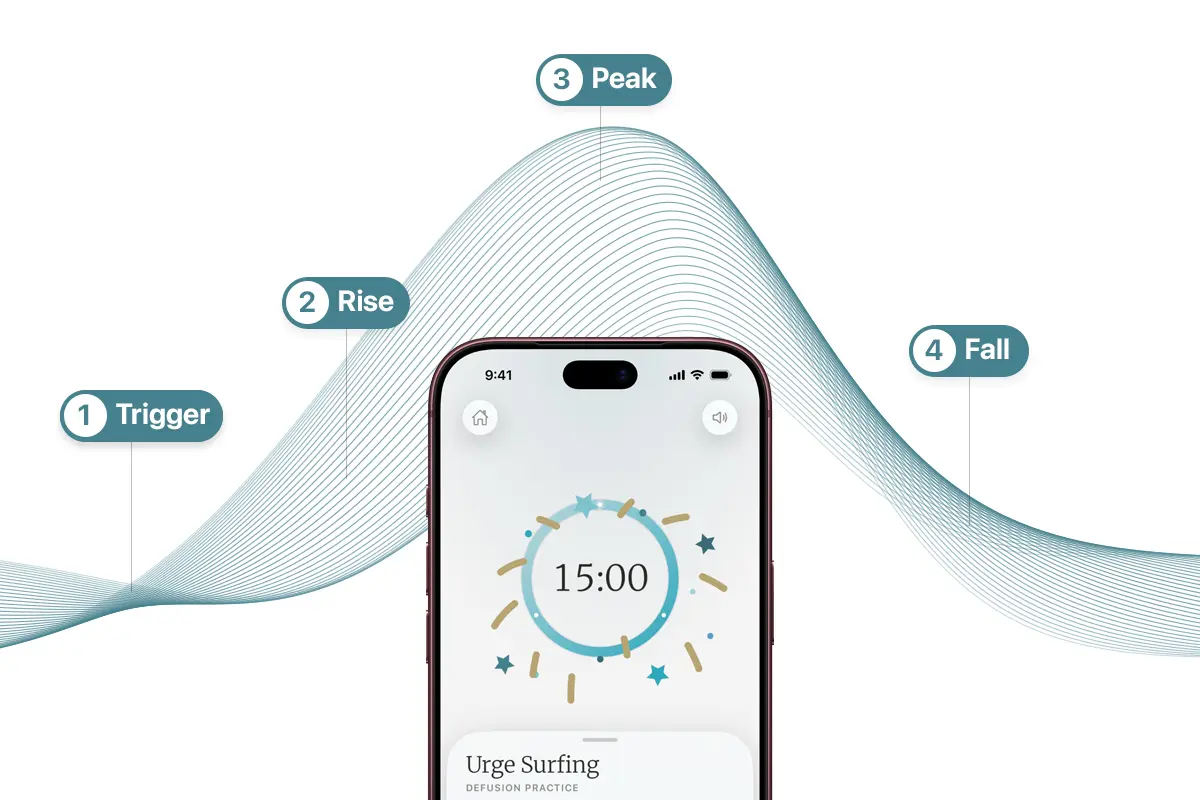
- Trigger. Something sets it off: a place, a time of day, a feeling, a smell.
- Rise. The pull gets stronger, and thoughts start making the case for acting on it.
- Peak. The urge is at its most intense. This is usually the hardest moment, and it doesn't stay.
- Fall. Left alone, the urge eases and fades.
Surfing the urge means watching that whole shape with curiosity: the sensations in your body, the thoughts that ride along with them, and how both change from one moment to the next.
How do you surf an urge?
Most versions share the same few moves:
- Pause. Sit or stand somewhere you can stay for a few minutes.
- Name it. Put a word to what you're feeling.
- Find it in your body. Chest, stomach, throat, hands. Notice where the pull sits.
- Notice its strength. Watch it get stronger or weaker without trying to change it.
- Use your breath as an anchor. When your attention drifts into the thoughts, come back to breathing, then back to the sensation.
- Stay until it turns. Keep watching as the wave passes its peak and starts to fall.
It doesn't need special conditions. It can happen at the kitchen counter, in the car, or in the middle of an evening that suddenly feels hard.
Trying it in Maureen
Maureen has an Urge Surfing module built on the same idea. It's one way to practice, with each step on its own screen:
- Name the urge. Give it a word, so it becomes something you can look at.
- Notice where it lives. Find the place in your body where you feel it.
- Rate the intensity. A quick score for how strong it feels right now.
- Create some distance. A short defusion step for stepping back from the thoughts that come with the urge, so you're watching them rather than taking orders from them.
- Ride the wave. A 15-minute timer starts as soon as you open the module, and whatever is left after the first steps is time to stay with the wave as it moves.
Urge surfing is often handed out as a paper worksheet: a printed wave with boxes for the trigger, rise, peak and fall, and questions to fill in afterwards. The module keeps the same steps and changes how you move through them:

- Dynamic. One prompt at a time, in order, instead of a full page of boxes at once.
- Interactive. You tap where the feeling sits on a body outline and rate it on the spot, and the timer keeps time so you don't have to.
- Accessible. It's on your phone, so it's there when an urge shows up, wherever you are. No printout, no pen.
Each session is saved. In Insights, your activity is grouped by behaviour, so over time you can see patterns in when urges show up.
However you practice it, the idea stays simple: an urge is a wave, and waves always pass.